
Blog
Do You Need a Drainage Impact Analysis in Lafayette?
Key Takeaways
- Lafayette Parish requires a drainage impact analysis for most new developments to ensure construction does not increase flood risk for neighboring properties.
- South Louisiana's flat terrain, high water table, and heavy rainfall make drainage planning especially critical — and costly if overlooked.
- A thorough drainage study identifies detention requirements, outfall routes, and permitting needs early, preventing expensive redesigns during construction.
- Working with a local civil engineer who understands Lafayette Parish drainage regulations can streamline approvals and reduce project delays.
What Is a Drainage Impact Analysis?
A drainage impact analysis is an engineering study that evaluates how a proposed development will change stormwater runoff patterns on and around a property. It determines whether your project will increase flooding risk for adjacent properties and identifies the infrastructure needed to manage that additional runoff.
When you develop raw land — whether for a subdivision, commercial site, or even a large residential lot — you replace permeable ground with impervious surfaces like rooftops, driveways, and parking lots. That change means more water runs off faster during rain events. A drainage impact analysis quantifies that change and designs solutions to offset it.
In Lafayette and across South Louisiana, this study is not optional for most projects. Lafayette Consolidated Government (LCG) and Lafayette Parish require developers to demonstrate that their project will not adversely affect downstream drainage before issuing permits. Without this analysis, your project will not move forward.
When Lafayette Parish Requires a Drainage Analysis
Lafayette Parish requires a drainage impact analysis for virtually all new development that adds impervious area or changes existing drainage patterns. This includes subdivisions, commercial construction, apartment complexes, and many residential projects exceeding certain thresholds.
The Lafayette Consolidated Government's engineering and development standards mandate that developers submit a drainage study as part of the development permit application. The study must demonstrate compliance with parish detention and outfall requirements. Specific triggers include:
- New subdivisions of any size
- Commercial or industrial site development
- Any project adding more than 10,000 square feet of impervious surface
- Re-development projects that significantly alter existing drainage patterns
- Projects within FEMA-designated flood zones that require floodplain development permits
If your property is in Broussard, Youngsville, Scott, or Carencro, each municipality may have additional drainage requirements on top of parish standards. Understanding which jurisdiction governs your project is one of the first steps in the development process.
What the Drainage Study Process Involves
A drainage impact analysis follows a structured engineering process that typically takes two to four weeks to complete, depending on site complexity and available data. Here is what to expect when your civil engineer begins the study.
Field Survey and Data Collection
The process starts with a topographic survey of the property to map existing elevations, drainage paths, and outfall points. Your engineer will also evaluate soil conditions, identify existing drainage structures, and review FEMA flood maps to determine your property's flood zone designation.
Hydrologic and Hydraulic Modeling
Using the survey data, your engineer builds computer models that simulate how stormwater flows across the site under various rainfall scenarios. The analysis typically models the 10-year and 100-year storm events to ensure the proposed drainage infrastructure can handle both routine rainfall and extreme weather. These models compare pre-development runoff to post-development runoff to quantify the change your project creates.
Detention Design and Mitigation
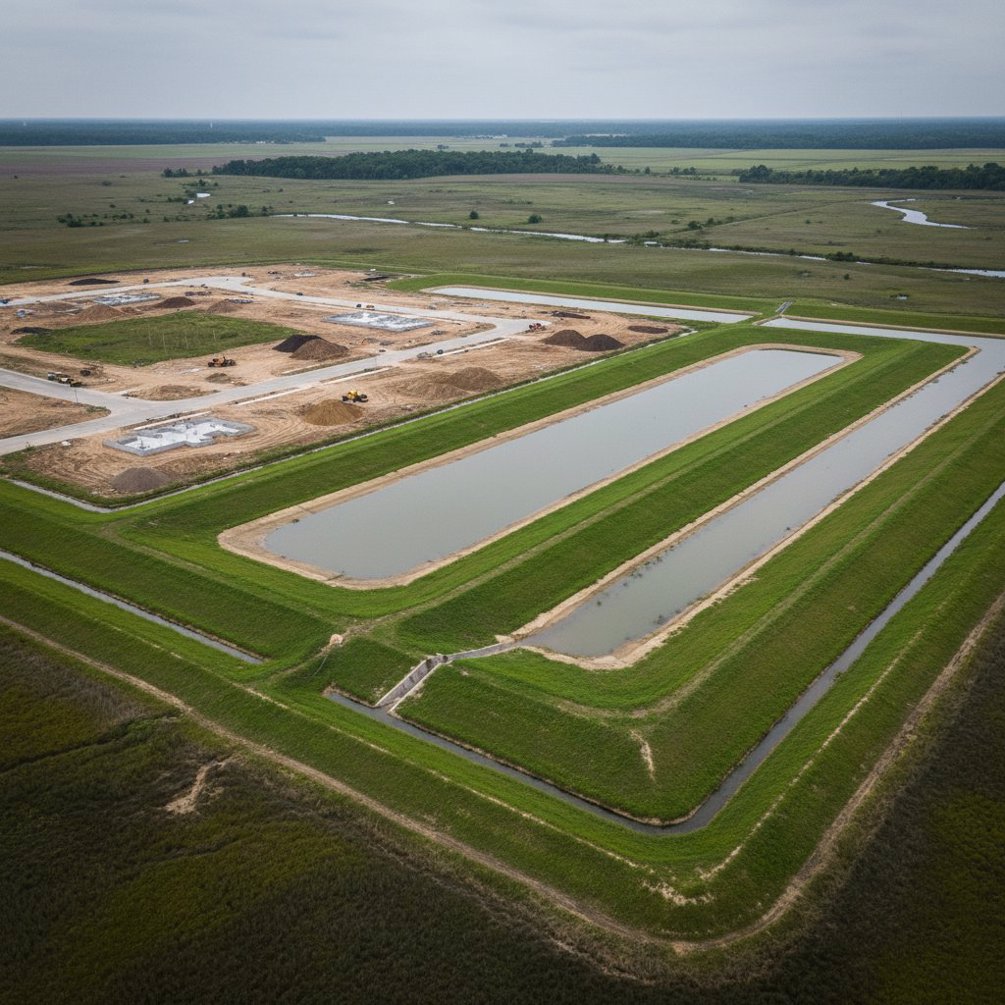
If the analysis shows increased runoff — which it almost always does for new development — your engineer designs detention facilities to temporarily hold excess stormwater and release it at a controlled rate. In Lafayette Parish, detention ponds are the most common solution, though underground detention systems are sometimes used on commercial sites where space is limited.
Report and Submittal
The final deliverable is a stamped engineering report that documents all findings, calculations, and proposed mitigation measures. This report is submitted to Lafayette Consolidated Government or the relevant municipality for review. The review process typically takes two to six weeks, and the reviewing agency may request revisions before approving the drainage plan.
Common Drainage Challenges in South Louisiana
Drainage engineering in the Acadiana region presents challenges that engineers in other parts of the country rarely face. Understanding these challenges helps explain why drainage analysis is so important here — and why hiring a local engineer with regional experience matters.
Flat terrain: South Louisiana is remarkably flat. Many properties in Lafayette Parish have less than two feet of elevation change across an entire development site. This means stormwater does not move quickly by gravity alone, and engineers must design systems that account for very low hydraulic gradients.
High water table: The water table in much of the Acadiana region sits just a few feet below the surface. This limits the depth of detention ponds and underground systems, and it can create challenges with construction dewatering during the building phase.
Heavy rainfall: Lafayette averages over 60 inches of rainfall annually, with intense summer storms that can drop several inches in a single hour. Drainage systems must be designed for these extreme events, not just average conditions.
Evolving flood maps: FEMA has been updating flood maps across Lafayette Parish, and properties that were previously outside the floodplain may now be within it. A current elevation certificate is essential for understanding your property's flood zone status before beginning development.
Downstream capacity: Many drainage outfalls in Lafayette Parish are at or near capacity. Your drainage study must account for downstream conditions, not just what happens on your site. If the existing coulee or canal system downstream cannot handle additional flow, your project may need to provide more detention than a simple site-level calculation would suggest.
How a Drainage Study Saves You Money
A drainage impact analysis is an upfront investment that prevents far more expensive problems during and after construction. Developers who skip or rush this step often face costly consequences that could have been avoided with proper planning.
Avoiding permit delays: An incomplete or inaccurate drainage study is one of the most common reasons development permits get rejected or delayed in Lafayette Parish. Each revision cycle adds weeks to your project timeline, and construction delays are expensive. Getting the drainage analysis right the first time keeps your project on schedule.
Right-sizing infrastructure: Without accurate modeling, developers either overbuild drainage infrastructure (wasting money) or underbuild it (creating liability). A proper analysis ensures detention ponds, pipes, and channels are sized correctly for the specific site conditions and regulatory requirements.
Reducing construction surprises: The drainage study reveals subsurface conditions, outfall limitations, and flood zone constraints early in the design process. Discovering these issues during construction — when a grading contractor hits the water table or a pipe route conflicts with an existing utility — is dramatically more expensive than identifying them on paper.
Protecting your investment: Properties with inadequate drainage suffer flooding, erosion, and infrastructure damage. For subdivision developers, drainage problems in a completed neighborhood create warranty claims, unhappy homeowners, and reputational damage. For commercial developers, a flooded parking lot or building means lost revenue and insurance complications.
If you are planning a development project in Lafayette, Broussard, or anywhere in the Acadiana region, investing in a thorough drainage impact analysis early in the planning process is one of the smartest decisions you can make. The team at Hensgens Trahan Engineering Consulting has designed drainage systems for projects ranging from 60-lot subdivisions to 900-lot master planned communities like Sugarmill Pond. Contact HTEC at (337) 443-0920 to discuss your project's drainage requirements.
Frequently Asked Questions
How much does a drainage impact analysis cost in Lafayette?
The cost of a drainage impact analysis in Lafayette typically ranges from $3,000 to $15,000 depending on the size and complexity of the site, the scope of the proposed development, and whether additional studies like floodplain modeling are required. Smaller commercial sites fall toward the lower end, while large subdivision projects with complex outfall conditions cost more.
How long does it take to complete a drainage study in Lafayette Parish?
A drainage impact analysis typically takes two to four weeks to complete from the start of the topographic survey to the delivery of the stamped engineering report. The subsequent parish review process adds another two to six weeks. Projects in FEMA flood zones or those requiring coordination with multiple drainage districts may take longer.
Do I need a drainage impact analysis for a single-family home in Lafayette?
Most individual single-family homes built on existing platted lots within an approved subdivision do not require a separate drainage impact analysis — the subdivision's original drainage study covers individual lots. However, if you are developing a large acreage tract for a single residence, or if your property is in a FEMA flood zone requiring a floodplain development permit, an analysis may be required.
What happens if my development increases flooding on neighboring properties?
Under Louisiana law, landowners can be held liable for diverting or increasing stormwater flow onto neighboring properties. This is known as the civil law principle of natural servitude of drainage. If your development causes flooding on adjacent properties, you could face lawsuits and be required to remediate the damage at your expense — which is far more costly than designing proper drainage infrastructure from the start.